Table of Contents
ToggleIntroduction
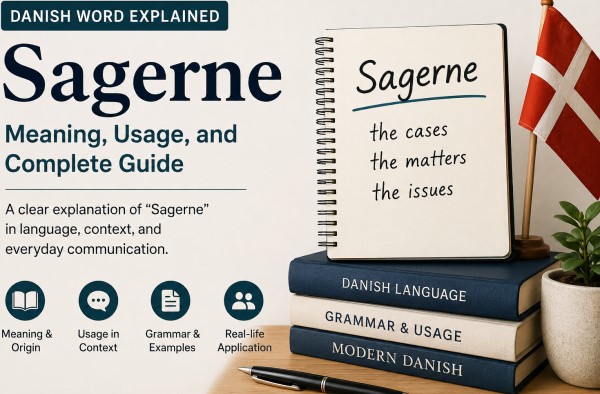
The term “Sagerne” may appear simple at first glance, but it carries meaningful depth depending on the context in which it is used. It is most commonly associated with the Danish language, where it translates broadly to “the cases,” “the matters,” or “the issues.” However, its use is not limited to legal discussions alone. It can be found in administrative, professional, and everyday conversational settings.
In this article, we will explore the meaning of Sagerne, its linguistic background, real-life usage, and why understanding such terms is useful for language learners, researchers, and global readers. By the end, you will have a complete understanding of how and when the term is used correctly.
What Does “Sagerne” Mean?
The word Sagerne comes from the Danish root word “sag”, which means:
- Case
- Matter
- Issue
- Subject
- Affair
When pluralised and given the definite form, it becomes “Sagerne”, meaning “the cases” or “the matters”.
In English, it does not have a single fixed translation because its meaning depends on context. Instead, it can be interpreted in several ways such as:
- The cases (legal or official)
- The issues (general problems or topics)
- The matters (subjects under discussion)
- The files or tasks (administrative usage)
This flexibility makes it a widely used term in Danish communication.
Linguistic Background of Sagerne
To understand Sagerne properly, it is important to break it down grammatically.
Root Word: “Sag”
The base word sag refers to a single case or matter. It is used in many formal and informal contexts.
Plural Form: “Sager”
When referring to more than one case, the word becomes sager.
Definite Plural Form: “Sagerne”
Adding the suffix -ne makes it definite plural, meaning “the cases” specifically known or already discussed.
This structure is common in Danish grammar, where nouns change form depending on definiteness and number.
How “Sagerne” Is Used in Everyday Language
The usage of Sagerne depends heavily on context. It can appear in multiple environments.
Legal Context
In legal systems, Sagerne often refers to court cases or ongoing legal matters.
Example usage:
“Dommeren gennemgår sagerne i dag.”
(The judge is reviewing the cases today.)
Here, it refers to official legal files or proceedings.
Workplace and Administration
In office environments, Sagerne can refer to tasks, documents, or ongoing work items.
Example usage:
“Vi skal afslutte sagerne inden fredag.”
(We must complete the tasks before Friday.)
In this case, it means assigned work or pending issues.
Everyday Conversation
In casual speech, Sagerne can be used more loosely to refer to matters or situations.
Example:
“Hvordan går det med sagerne?”
(How are things going with the matters?)
It may refer to personal issues, plans, or ongoing situations.
Media and Journalism
In news or reporting, Sagerne may describe current stories, investigations, or topics being covered.
Example:
“Journalisterne dækker sagerne tæt.”
(The journalists are closely covering the cases.)
Why the Term “Sagerne” Is Important in Language Learning
Understanding words like Sagerne is valuable for several reasons:
Improves Language Comprehension
It helps learners understand how meaning changes with grammar structure.
Enhances Contextual Understanding
Since the word can mean different things depending on usage, it trains readers to interpret context carefully.
Builds Vocabulary Depth
Learning such terms expands knowledge beyond direct translations.
Useful for Translation Accuracy
Translators must know that “Sagerne” cannot always be translated word-for-word.
Differences Between “Sag,” “Sager,” and “Sagerne”
To fully understand the term, it is helpful to compare its forms.
Sag
- Singular form
- Means one case or matter
- Example: one issue or file
Sager
- Plural form
- Means multiple cases or matters
- Example: several issues or files
Sagerne
- Definite plural form
- Means the specific cases being referred to
- Example: the known or discussed cases
This distinction is important in proper Danish grammar usage.
Practical Examples of “Sagerne”
Below are some natural sentence examples:
- “Sagerne er blevet behandlet hurtigt.”
(The cases have been handled quickly.) - “Vi diskuterer sagerne i mødet.”
(We are discussing the matters in the meeting.) - “Sagerne kræver yderligere undersøgelse.”
(The cases require further investigation.)
These examples show how flexible and context-driven the term is.
Common Misunderstandings About “Sagerne”
Many non-native speakers misunderstand Sagerne because:
No Exact English Equivalent
It can mean “cases,” “matters,” or “issues,” depending on usage.
Context-Dependent Meaning
Without context, translation can be misleading.
Formal Usage
It is more common in structured or official communication than in casual speech.
Modern Usage and Relevance
In modern Danish communication, Sagerne remains widely used across:
- Government documentation
- Legal systems
- Business environments
- Media reporting
- Daily conversations
Even in digital communication, the term is still relevant when referring to files, cases, or topics being tracked or managed.
Why Words Like “Sagerne” Matter in Global Communication
Understanding such terms is useful because:
- International businesses interact with Danish institutions
- Legal documents may include such terminology
- Language learners encounter it in translation
- It improves cross-cultural understanding
Conclusion
The word Sagerne is a strong example of how language carries multiple meanings depending on context. Originating from Danish, it refers broadly to cases, matters, or issues. Whether used in legal systems, workplaces, or everyday conversation, its meaning always depends on usage.
By understanding its structure and application, learners gain deeper insight into both grammar and communication. Ultimately, Sagerne reflects how language adapts to clarity, organisation, and context-driven meaning.